Swing gates need clear space for their panels, called leaves, to sweep through. Sliding gates need space beside the opening for the gate to retreat into. Start with those two areas, the ground levels and where your car will wait; choose the appearance once an installer has confirmed a workable layout.
Neither arrangement suits every entrance. A short driveway may favour a sliding gate, but a wall, tree or neighbouring boundary can leave nowhere for it to go. A wider forecourt may accommodate swing gates while still leaving space for a parked car.
Compare the space each gate uses
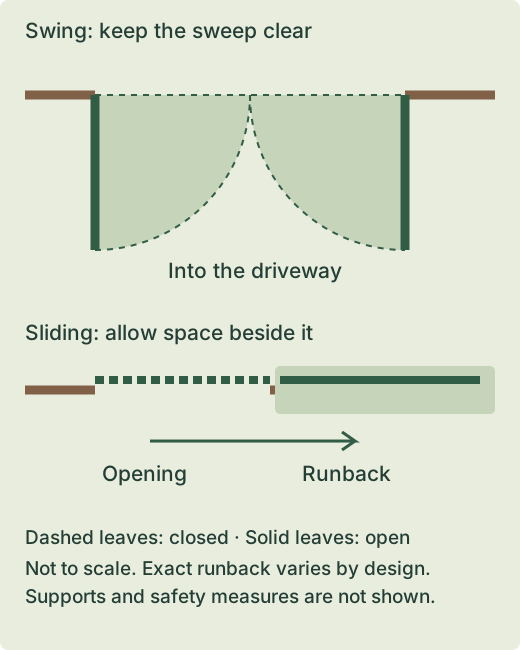
| Site question | Swing gate | Sliding gate |
|---|---|---|
| Where does it move? | Through an arc from its hinge posts | Along the boundary beside the opening |
| What must stay clear? | The full sweep of each leaf | The opening and the complete side travel area |
| Where might a car obstruct it? | Within the opening arc | Beside the gate's travel path or across the entrance |
| What should the survey show? | Leaf positions, opening angles and ground clearance | Clear opening, total gate length and required runback |
Hörmann offers both layouts, including single- and double-leaf swing gates. Ask for a drawing showing the proposed gate fully closed and fully open. Include bins, planting, parked vehicles and the pedestrian route on that drawing.
Swing gates: check the whole opening arc
A gate that fits neatly between two posts may still meet a rising driveway as it opens. Ask the surveyor to check levels throughout the sweep, rather than only beneath the closed gate. Do not assume that shortening the leaves or increasing the gap below them is an acceptable fix.
Consider everyday arrivals, too. Where will a vehicle stop while the gate opens? Can someone reach the front door on foot without walking through the moving leaves? If a second car is already parked, does the proposed opening still work?
An outward-opening design needs a separate boundary and highways check. Read the outward-opening gate guide and ask the relevant authority before specifying it.
Sliding gates: allow for the complete gate
“Runback” means the space alongside the entrance that the gate occupies when open. Measure the available area for the survey, but ask the installer to confirm the required length for the exact design. Opening width alone does not establish that a sliding gate fits.
There are two common arrangements. Jacksons explains that a tracked gate uses wheels on a ground track across the opening. The track needs suitable support and must remain clear of debris. Ask how the design handles drainage and the driveway surface.
A cantilever gate is supported from one side and has no ground track across the entrance. Its counterbalancing section makes the complete gate longer than the opening it spans. It also needs a suitable supporting foundation. Ask for both the runback and foundation footprint; a track-free entrance does not mean groundworks disappear.
Slopes need a surveyed design
Distinguish a drive rising behind the entrance from ground sloping along the gate's travel direction. These create different constraints. Jacksons describes cantilever gates as an option for spanning uneven ground or an opening with rising ground behind it, but that does not establish suitability for every sloping site.
Ask the installer to show the proposed travel line, ground clearance and support positions on a measured drawing. Avoid choosing a motor or ordering a gate before these details are settled.
Automation changes the safety questions
HSE's safety guidance identifies hinge crushing points, sliding-gate shear gaps, wind loads and uncontrolled movement on slopes among the hazards to address. A photocell or safety edge alone does not establish that the complete installation is safe.
Ask who assesses the complete installation, how access to trapping points is controlled, and how protective measures will be checked. HSE's basics page also explains the need for user instructions, conformity documentation and maintenance. Request a demonstration of safe operation and the prescribed emergency release at handover. Do not adjust forces or bypass safety devices yourself.
Get comparable proposals
Ask each installer to quote for the surveyed gate, posts, foundations, track or cantilever supports, drainage work, automation, electrical work, protective measures and making good. Confirm what happens during a power cut and what servicing the manufacturer requires. Use the quote comparer to record inclusions and unanswered questions.
Layout does not settle planning permission. The Planning Portal's England guidance includes height, listed-building and removed-rights conditions. For the other nations and local restrictions, start with our gate planning guide, then confirm the proposal with your council.
Sources & further reading
- Hörmann: sliding gates and swing gates
- Jacksons: how sliding gates work
- HSE: ensuring powered doors and gates are safe
- HSE: powered gate basics
- Planning Portal: fences, gates and garden walls in England
Checked 2026-10-26. Specifications and rules can change; confirm before ordering or starting work.